

–
November 5, 2026
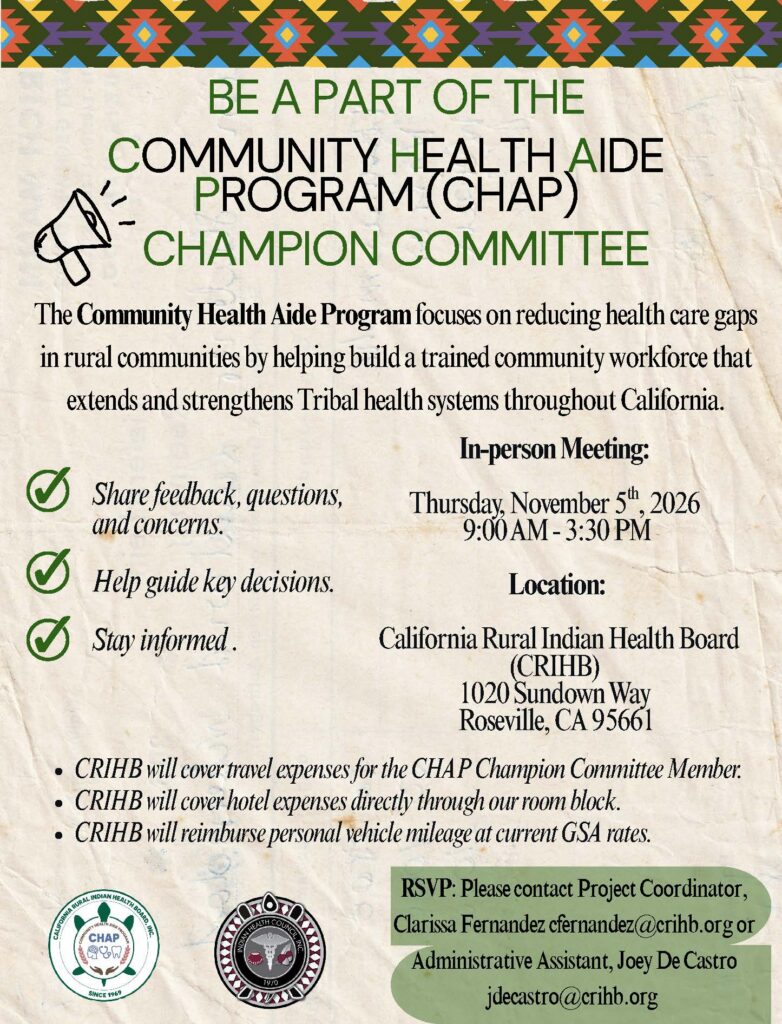
COMMUNITY HEALTH AIDE PROGRAM (CHAP)
Share feedback, questions, and concerns. Help guide key decisions. Stay informed.
RSVP: Please contact Project Coordinator, Clarissa Fernandez at cfernandez@crihb.org or Administrative Assistant, Joey De Castro at jdecastro@crihb.org.
The California Rural Indian Health Board (CRIHB) and Indian Health Council (IHC) partnered to create the CHAP Champion Committee, ensuring that the Community Health Aide Program (CHAP) is informed and guided by the people and communities it is intended to serve. As a reminder, CHAP focuses on reducing health care gaps in rural communities by helping build a trained community workforce that extends and strengthens Tribal health systems throughout California.
Your voice is essential in shaping how CHAP is implemented throughout California. Whether you choose to share your thoughts during the meeting, submit written feedback, or connect with us one-on-one, we welcome your input in whatever way feels most comfortable for you.
Meeting Information
We are pleased to invite you to our next in-person CHAP Champion Committee Meeting:
Thursday, November 5, 2026
9:00 a.m. - 3:30 p.m.
Location:
CRIHB Board Room A & B
1020 Sundown Way
Roseville, CA 95661
Travel Information
Please review the following travel information carefully:
- CRIHB will cover travel expenses for the CHAP Champion Committee Member.
- CRIHB will cover hotel expenses directly through our room block.
- CRIHB will reimburse personal vehicle mileage at current GSA rates.
- Per diem will be calculated based on the length of stay in Roseville, including travel time to and from Roseville.
- Mileage reimbursement will be based on travel from your designated starting location to the hotel, hotel to CRIHB, CRIHB to the hotel, and return travel.
- If you will be traveling by another mode of transportation (flight, company vehicle, etc.), please let us know in advance to obtain prior approval (at least 10 business days in advance).
Hotel Information
Hilton Garden Inn Roseville
1951 Taylor Road
Roseville, CA 95661
Check-In: Wednesday, November 4, 2026, at 3:00 p.m.
Check-Out: Friday, November 6, 2026, at 12:00 p.m.
Please be prepared to provide a personal credit card at check-in for incidental charges.
If you plan to be in attendance, please contact me and/or Joey DeCastro @De Castro, Joey (CRIHB) to confirm travel accommodations.
If you have any questions regarding travel arrangements or reimbursements, please do not hesitate to reach out to me directly.
Thank you for your continued partnership and commitment to this important work. We look forward to seeing you in Roseville and continuing our efforts to strengthen Tribal health systems throughout California.
Virtual Option:
Topic: CHAP Champion Committee Meeting
Time: Nov 5, 2026 9 AM Pacific Time (US and Canada)
Join Zoom Meeting
https://crihb.zoom.us/j/88536060655
Meeting chat link
https://crihb.zoom.us/launch/jc/88536060655
Meeting ID: 885 3606 0655